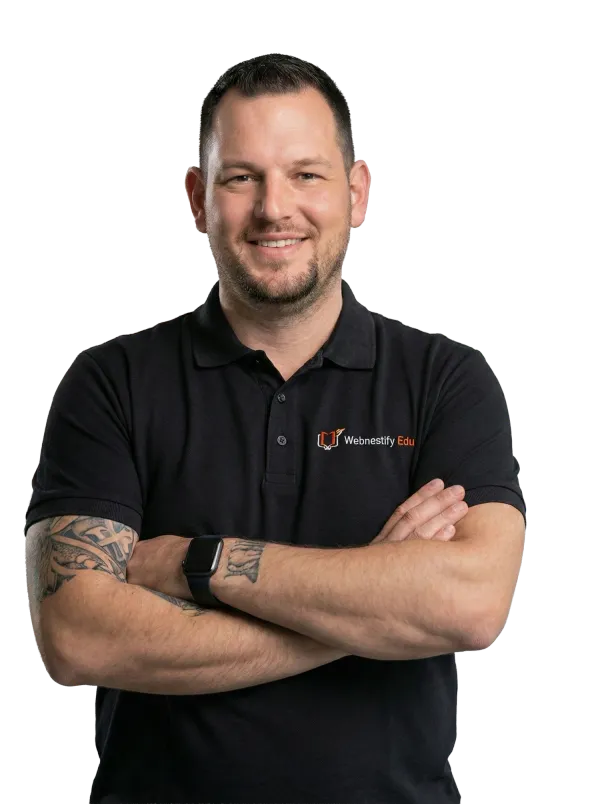
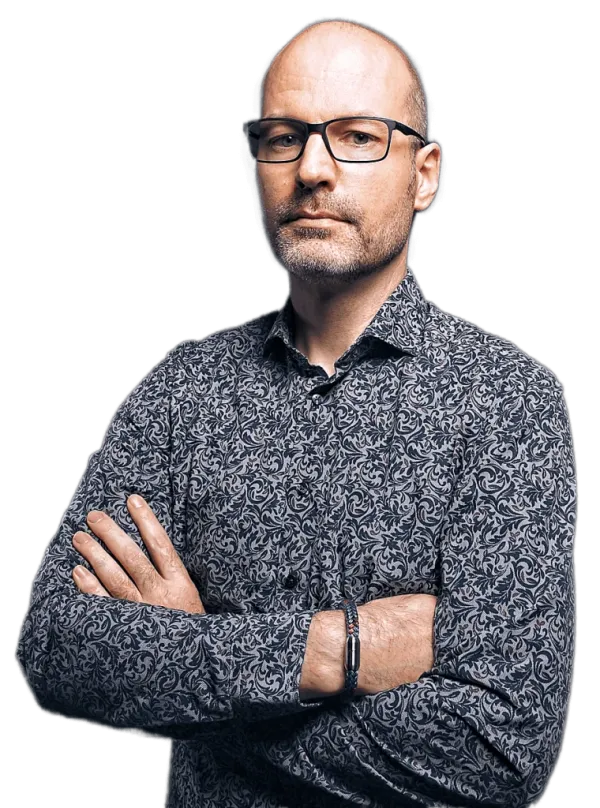
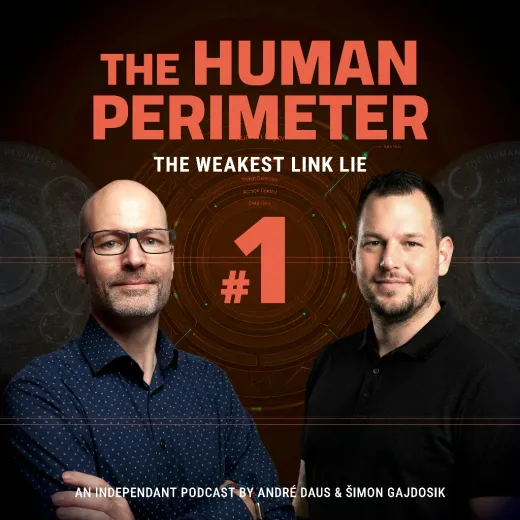
The Human Perimeter podcast cover — Simon Gajdosik and André Daus

People are not the vulnerability. They are the perimeter.

The cybersecurity industry spent decades calling people the weakest link. We think they got it backwards. This show is about where security breaks down, and where it holds.

Every second Tuesday.
18:00 CET.
Live on YouTube.

Tune in live and your questions get answered on air. Miss the stream and the recording goes up on Spotify, Apple Podcasts, YouTube, and via RSS the same evening.

Each episode follows the same shape

  1. 01
    The main topic A story, a breach, a pattern, a question.
  2. 02
    Audience Q&A Live questions and listener stories. The chat steers the conversation, not whoever super-chatted hardest.
  3. 03
    What's Your Move? One concrete thing you can do this week to protect yourself, your family, or your business.

Episodes run 30 to 60 minutes. Biweekly schedule.

Tomorrow
Tuesday, 5 May 202618:00 CET Episode 1 · Live on YouTube

The $25 Million Call That Never Happened

A finance worker joined a video call with his CFO and colleagues. Every person on screen was a deepfake. He made 15 wire transfers before anyone noticed.

By the time the truth came out, $25 million was gone. One of the world's largest engineering firms had to publicly admit it could not prove who was on the other end of a video call. In episode 1 we walk through the Arup deepfake heist: how the attack actually worked, why every "verified meeting" you have ever taken trusts the same shaky assumption, and what to do before synthetic-video calls land in your inbox.

Bring your questions to the live Q&A. If you can't make it, drop them in r/HumanPerimeter and we'll pick them up on air.

Source for the case discussed: Fortune — Arup deepfake CFO scam, Hong Kong

Every major breach follows the same script. Not a genius exploit. Not a zero-day. It starts with a person.

Someone clicks a link. Someone reuses a password. Someone trusts a voice on the phone that sounds exactly like their boss. Because now it can.

The technology keeps getting better. The firewalls get smarter. And the attacks still get through, because they stopped aiming at the machines a long time ago. They aim at us.

At the moment we are distracted, tired, trusting, or just never taught what to look for.

Each episode starts with a simple question: what's the perimeter today? Sometimes the answer is a phishing campaign that fooled an entire department. Sometimes a deepfake call that nearly moved six figures out of a company account. Sometimes one person who noticed something felt wrong and stopped an attack cold.

No jargon unless we explain it. No scare tactics. No sponsors. Real stories, plain language, for smart adults who just have not been given the right information yet.

Phishing

How attacks exploit trust, not technology.
Social Engineering

The psychology of manipulation.

Deepfakes

When the voice on the phone can be anyone.

Insider Threats

Attacks that start from the inside.

01

The Gap

Most cybersecurity content is either deeply technical and written for people who already know, or surface-level advice that stops at "use strong passwords." Almost nothing sits in between.
02

The Stakes

Kids go online before anyone teaches them what a scam looks like. Seniors lose savings to fraud a ten-minute conversation could have prevented. Small businesses get breached and never recover.
03

The Belief

Digital safety is a right, not a product. Education is the strongest first line of defense. A person who knows what to look for is the perimeter that holds.

One builds the wall.

Simon knows how attacks work, how infrastructure fails, and what the fix looks like at three in the morning.

The other asks why everyone assumed it was strong enough.

André knows why people fall for things, and what it takes to make questioning feel normal instead of uncomfortable.

No sponsors. No vendor agenda. No scare tactics.

Two people with the right experience decided to spend their free time doing the right thing. Our only agenda is that more people learn to protect themselves before something goes wrong. Not after.

Have a story, a question, or something you want us to cover?

We want to hear from people who have been inside a breach, run a security team, noticed something that did not feel right, or just want to understand what they are up against. Real stories. No pitch decks.

Frequently asked questions

  • What is The Human Perimeter?
    An independent cybersecurity podcast about the human side of security. We cover phishing, social engineering, deepfakes, insider threats, and the everyday decisions that decide whether an attack lands. New episodes go live on YouTube every second Tuesday at 18:00 CET, with audience Q&A on air.
  • Who is the show for?
    Smart adults who use the internet: founders, professionals, parents, seniors, security teams, and anyone tired of cybersecurity content that is either too technical to follow or too surface-level to act on. We explain technical terms when we use them, and we do not talk down.
  • Why "the perimeter" instead of "the weakest link"?
    The cybersecurity industry has been calling people the weakest link for decades. We think they got it backwards. Most attacks succeed because attackers stopped aiming at machines a long time ago. They aim at people. A person who knows what to look for is the perimeter that holds. (André pushes back on this framing in the trailer episode. That disagreement is the whole point of the show.)
  • Who are Simon and André?
    Simon Gajdosik is the founder of Webnestify Education and runs Webnestify, a managed cloud and security agency in Bratislava. He brings infrastructure war stories to the show. André Daus is an independent risk consultant in Cologne, Germany, with 25+ years in banking and financial risk. He brings Red Team thinking, the contrarian mindset that stress-tests assumptions before reality does. Full bios on the Hosts page.
  • Why is the podcast independent and sponsor-free?
    Because we want to be honest about what works and what does not. Sponsors and vendor relationships introduce a quiet pressure to soften criticism of products that pay the bills. We refuse that pressure by refusing the money. The show is supported by Webnestify Education, the volunteer time of its hosts, and listener donations.
  • Isn't Simon running a security business a conflict of interest?
    We think it is the opposite. Simon's day job at Webnestify means he sees real attacks against real clients every week. Those firsthand stories are part of the value of the show. To keep it clean: the podcast is editorially independent, runs under a separate non-profit (Webnestify Education, o. z.), and contains no commercial promotion of Webnestify products. Where a client relationship is relevant to a story, we disclose it in the episode.
  • What is Webnestify Education?
    Webnestify Education, o. z. is a registered Slovak občianske združenie (civic association). Its mission: make cybersecurity education accessible. We are starting in Slovak primary schools by lobbying for it as a mandatory class, and we plan to take it global from there. The Human Perimeter is the flagship project. Bookkeeping is public, donations are open. More at webnestify.org.
  • How can I support the show?
    A few ways. Listen and tell one other person about it. Join r/HumanPerimeter and bring questions, stories, and topics we should cover. Donate to Webnestify Education at webnestify.org. There are no Patreon tiers and no super-chat priorities. The most useful thing you can do is share the show with someone who needs it.