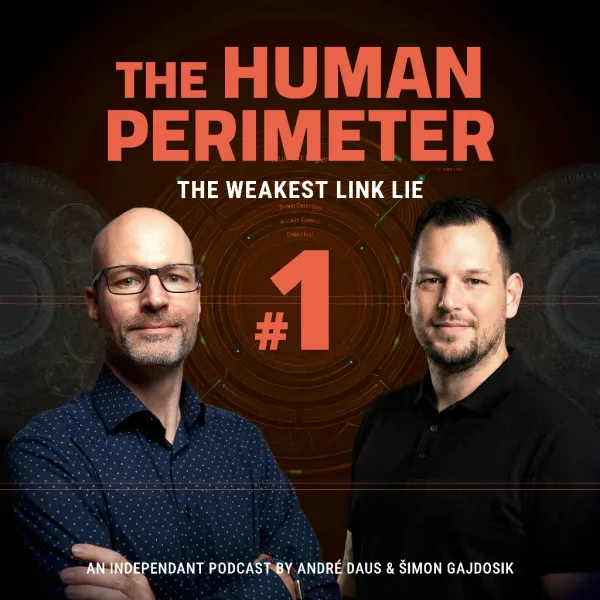
Why Cybersecurity Has Been Thinking About People All Wrong
The cybersecurity industry spent decades calling people the weakest link. We think they got it backwards. People aren't the vulnerability. They're the perimeter. The trailer episode of The Human Perimeter.
Key Takeaways
- → The cybersecurity industry has spent decades calling people the weakest link. We think they got it backwards.
- → Two perspectives on every episode — Simon's infrastructure side and André's adversarial Red Team thinking — and they don't always agree.
- → New episodes go live every second Tuesday at 18:00 CET on YouTube, with audience Q&A in real time.
- → No sponsors. No fear-mongering. No jargon we don't explain.
What this trailer is about
Simon Gajdosik and André Daus introduce The Human Perimeter in this opening episode. The show is about the human layer of cybersecurity: where breaches start, and where they can be stopped.
The episode opens with the show’s central thesis: the cybersecurity industry has spent decades calling people the weakest link, and they got it backwards. People aren’t the vulnerability, they are the perimeter. That framing is also where Simon and André disagree. André pushes back almost immediately. That tension is the whole point of the show.
Meet the hosts
Simon Gajdosik runs Webnestify, a managed cloud and security company that serves agencies and businesses worldwide. He has spent years on the infrastructure side of cybersecurity, building servers, locking them down, and cleaning up after things go sideways. He started Webnestify Education because he kept watching the same pattern: people getting hit by attacks that five minutes of the right training could have prevented.
André Daus is an independent consultant based in Cologne, Germany. He has spent over twenty-five years getting organizations to confront the questions they would rather skip. His background is in banking and financial risk, but he built his reputation on something simpler: walking into a room and asking why everyone assumed they were safe. He calls it Red Team thinking, the contrarian mindset that stress-tests assumptions before reality does. He also hosts the Iconoclast Insights podcast.
In André’s words during the trailer:
“Red Team thinking is something that has been developed by the US Army because, during the Iraq war, they realized many people on the front had much more information than the ones who were in the back, like the generals in the Pentagon. They didn’t have all the information available to make better decisions. Red Team thinking brings this together into the business world.”
One builds the wall. The other asks why everyone assumed it was strong enough.
What we’ll cover on this show
Upcoming topics, where Simon’s practical infrastructure stories meet André’s contrarian perspective:
- Phishing and social engineering: the psychology behind why smart people still click
- Deepfakes and voice cloning: attacks that target trust instead of systems
- Insider threats: the warning signs organizations learn to ignore
- Red Team thinking applied to everyday security decisions
- War stories from highly-regulated industries like financial services
- What actually works, and what the industry keeps selling that doesn’t
The mission behind this show
The Human Perimeter is the flagship project of Webnestify Education, o. z., a registered Slovak občianske združenie. The mission: make cybersecurity education accessible. We’re starting in Slovak primary schools by lobbying for it as a mandatory class, and we plan to take it global from there.
Everything is transparent: bank statements are public, donations are open. The podcast has no sponsors, no vendor agendas, no scare tactics. Two people with the right experience decided to spend their free time doing the right thing.
How the live format works
We record episodes live on YouTube every second Tuesday at 18:00 CET. Tune in, and your questions in the chat get answered on air. The recording goes up on Spotify, Apple Podcasts, YouTube, and via RSS the same evening.
Each episode follows the same shape:
- The main topic: a story, a breach, a pattern, a question
- Audience Q&A: live questions and listener stories
- What’s Your Move?: one concrete thing you can do this week to protect yourself, your family, or your business
Episodes run 30 to 60 minutes, sometimes up to 75 if the conversation earns it. Biweekly schedule.
Where to engage between episodes
- Live questions: tune in to the YouTube livestream every second Tuesday at 18:00 CET
- Email: hello@human-perimeter.com — questions, stories, topic ideas. We read everything and pick the best ones up on air.
- Newsletter: short note when a new episode drops, nothing else
Subscribe wherever you get your podcasts. See you in episode one.
Frequently asked questions
-
What is "Red Team thinking" and how does it apply to cybersecurity?
Red Team thinking is the habit of asking "what if everyone here is wrong?" before reality forces the question. André picked it up from a US Army practice during the Iraq war, where front-line operators kept seeing things the Pentagon didn't and the Red Team's job was to challenge the comfortable view from the top. On the show, that's what he does with security assumptions, Simon's included. -
Where do Simon and André actually disagree?
The trailer opens with the show's central claim, that people are the perimeter, not the weakest link. André pushes back almost immediately. He argues that calling people the perimeter is a flattering rebrand of "weakest link" and the real work is harder than swapping the slogan. That disagreement is the whole point of the show. Simon comes from the infrastructure side and tends to be hopeful about training; André's two decades of financial-sector Red Team work make him skeptical that training fixes the actual problem. -
What is the "What's Your Move?" segment?
"What's Your Move?" is the closing segment of every episode. One concrete action small enough that you'll actually do it before the next episode airs. Setting a family code phrase, say, or moving from SMS-based 2FA to an authenticator app. The point is you leave with one thing to do, not a list of things to fear.